AI Chatbots
How to Choose an AI Chatbot Development Company: A Checklist
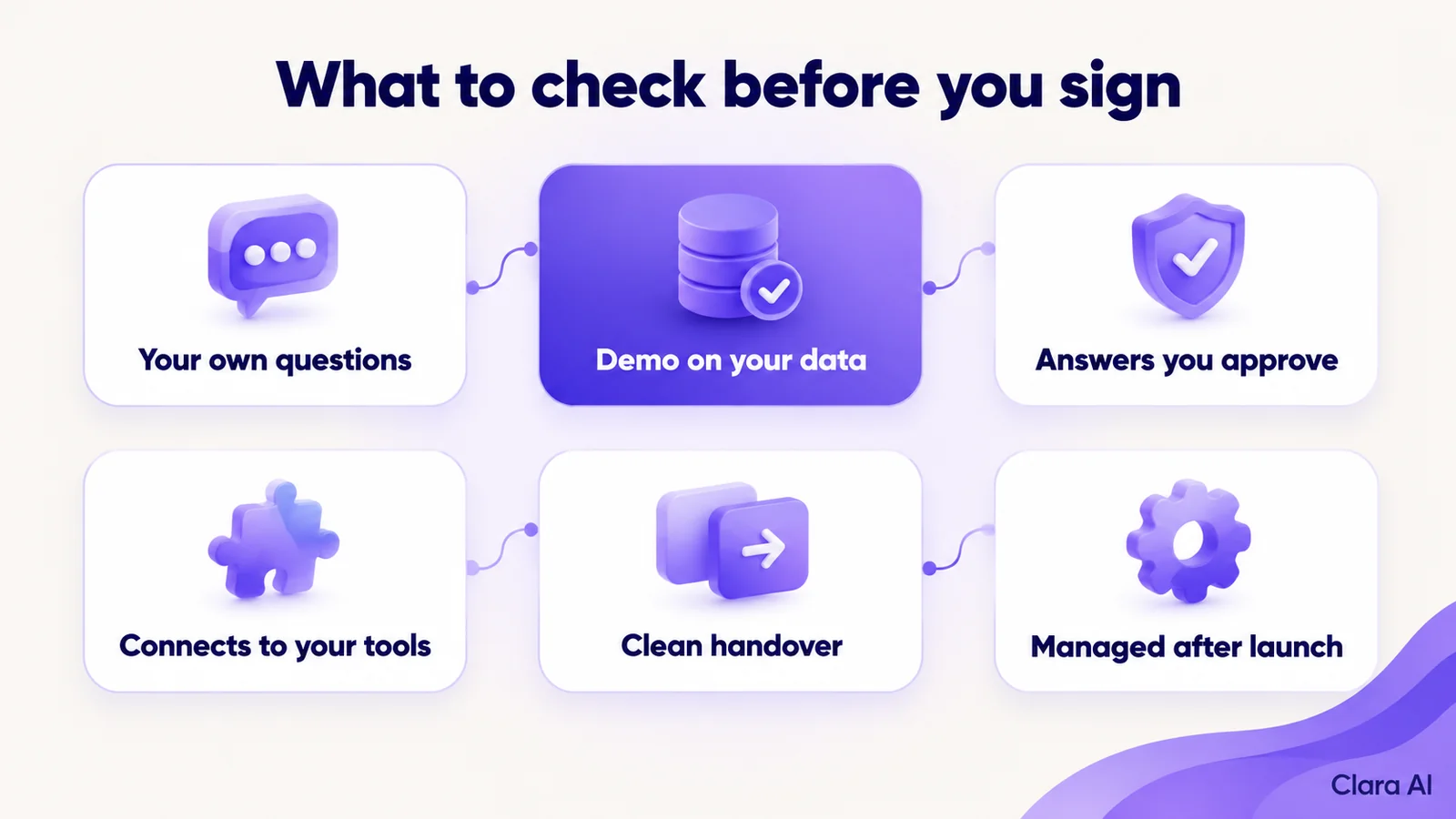
Choose an AI chatbot development company that builds from your own questions and documents, shows a working demo on your material before you sign, answers only from approved knowledge, hands over to a person with full context and manages the bot after launch. Use the ten checks below to compare vendors.
The owner of a mid-size distribution business has three proposals on her desk. All three promise "AI". One is a low-cost template bot. A friend bought one last year, and it still answers questions about a product line that was discontinued. The second vendor's demo looked impressive, but it ran on sample content. When she typed a real customer question, it gave a vague answer. The third proposal is the longest, and she cannot tell what she would actually receive.
This checklist is for owners and operations heads at established US and Canadian businesses with no in-house tech team. It is written to help you ask better questions, whichever vendor you pick.
Does the vendor start from your real questions and documents?
A good build starts with what your customers actually ask. That means past emails, chat logs, call notes, your product sheets and your policies. A template bot starts from a generic script and asks you to fit your business into it.
Ask the vendor how they will find your top customer questions. A sound answer includes a review of your own inquiries and documents before any design work begins.
Can they show a demo on your own material?
Do not sign on the strength of a demo built on someone else's content. Ask for a working version on yours, using your real documents and your real questions, before you commit.
Clara AI delivers a first demo within 7 days of receiving your material. Whoever you choose, ask for a date. If a vendor cannot show anything on your content until after contract, treat that as information.
Does the bot answer only from approved knowledge?
A chatbot that guesses is worse than no chatbot. Ask how the bot is limited to your approved content. It should be able to open the source behind an answer, and it should say "I don't know" when your documents do not cover a question. Then it should offer a person.
Test this yourself during the demo. Ask something your documents do not cover and watch what it does.
Does it connect to your CRM, calendar and helpdesk?
Answering questions is half the job. The other half is action. A useful chatbot can capture a lead, book a slot, check an order status or open a ticket, and it writes each result to the system your team already uses.
Ask which systems the vendor has connected before and what is possible with yours. Where a direct connection is not possible, ask what the workable alternative is.
How does handover to a person work?
The handover decides how customers feel about the whole bot. Ask these questions:
- Who receives the conversation, and in which tool?
- Does the person see the full chat, or only a name and a number?
- What happens outside staffed hours?
- Can a customer ask for a person at any time?
A good handover means nobody repeats themselves.
Who manages the chatbot after launch?
This is where most template bots fail. Products change, prices change and policies change. A bot nobody updates slowly goes wrong.
Ask who monitors the chats, who fixes wrong answers, who updates the knowledge when your business changes and how often. Ask what you receive at the end of each month. "You can log in and edit it yourself" is not a management plan for a team with no technical staff.
Can you see what customers ask?
Every conversation is data about your customers. Ask whether chats are summarised and whether you can see the top questions, the questions the bot could not answer and the number of handovers.
An operations intelligence dashboard can turn those summaries into one view, so you fix the gaps in your website, pricing or policies and not only in the bot.
How are privacy and data handled?
Chats can hold personal information. US state privacy laws may apply to your business, and for health businesses HIPAA may apply as well. Clara AI builds within the client's own rules. This is not legal advice, so confirm your obligations with your legal adviser, and ask every vendor how they handle consent, access and retention.
Which languages does it support?
Ask for the languages your customers actually use and ask to see each one tested. Clara AI's chatbots and calling agents work in English and Hindi. Ask any vendor, including us, to prove every language you need on your own content before you rely on it.
Is the scope clear, and who owns your data?
Get this in writing:
- what is included, and what is not
- which channels are covered, such as web and WhatsApp
- who owns the chat records, the knowledge base and the prompts
- whether you can export your data if you leave
Vague scope leads to disputes later. If your data cannot leave with you, you are renting access, not owning an asset.
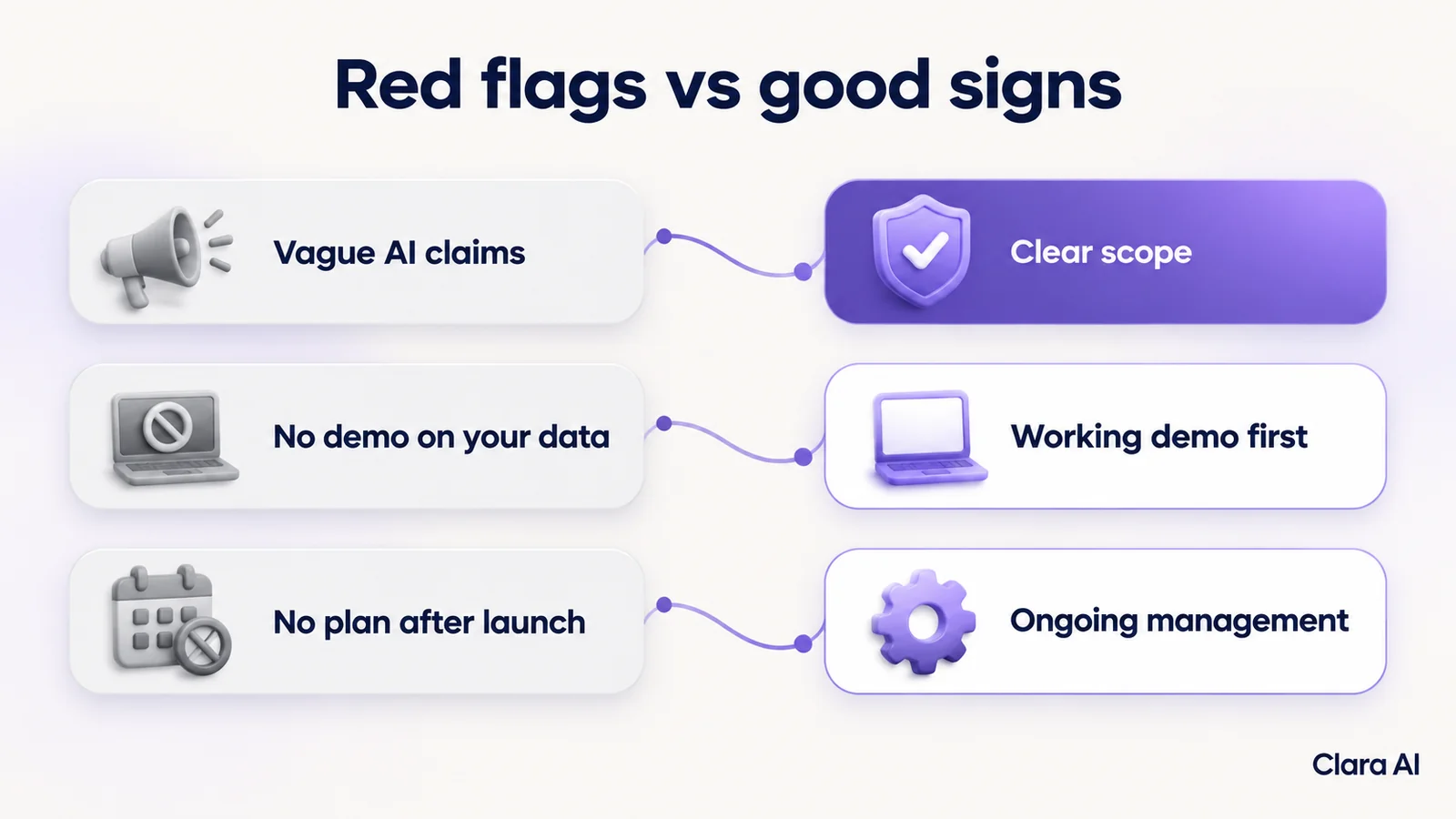
What are the red flags?
- Vague "AI" claims. The proposal says what the technology is, not what the bot will do for your customers.
- No demo on your data. Everything shown uses sample content.
- No plan after launch. The contract ends at go-live.
- Locked-in data. You cannot export your chats or knowledge.
- No human route. The bot has no clear way to reach a person.
- Promises of full automation. A vendor who says people will no longer be needed has not run a chatbot in a real business.
Ten questions to ask every vendor
Take this list into each call.
- How will you find our customers' most common questions?
- Can you show a working demo on our own documents before we sign, and by what date?
- How do you stop the bot guessing, and what does it say when it does not know?
- Which of our systems can it connect to, and which actions can it take?
- How does handover work, and what does the person see?
- Who monitors and updates the bot after launch, and how often?
- How will we see what customers ask and where the bot fails?
- How do you handle consent, access, retention and the privacy rules that apply to us?
- Which languages are supported, and how are they tested?
- What is in scope, who owns the data and can we export it?
Where should a North American business start?
For most US and Canadian businesses, start with the website. An AI web chatbot helps visitors who already have a question, and it needs only a browser. Add WhatsApp where your customers already use it, for example for repeat buyers or customers abroad. Our guide to web chatbot vs WhatsApp chatbot explains how to choose between the two.
If your questions depend on a large product range, read our guide to an AI web chatbot for industrial product catalogue support. If you need something more specific, such as sorting support emails, a custom AI agent may fit better.
Who has Clara AI built chatbots for?
Clara AI has built a web chatbot for Tempsens, an industrial manufacturer, that answers product catalogue questions. For Apex Hospitals, a healthcare group, it has built a WhatsApp chatbot for patient queries and appointment help. These clients are in India, and Clara AI works with companies in North America. We publish no results here, so we make no claims, and your own build depends on your content and systems. See our client work.
How Clara AI gets it built
Clara AI builds, deploys and manages chatbots in six steps.
- Diagnose how inquiries are handled today. We map your channels, who replies and where customers wait. We measure the baseline before we build.
- Collect your material. You share documents, common questions, past chats and emails. Clara AI delivers a first demo within 7 days of receiving your material.
- Agree the rules. Your team approves what the bot answers, what goes to a person and who receives each handover.
- Build and test on your real data. Past customer questions go through the bot, and every weak answer is corrected before launch.
- Run beside your team. The chatbot goes live while staff watch the chats and step in.
- Keep managing and improving. We monitor results against the baseline, fix wrong answers and update the knowledge as your business changes.
Questions buyers ask before hiring a chatbot company
How much does an AI chatbot development company charge?
Cost depends on the channels, the size of your content, the systems the bot connects to and the support you want after launch. Clara AI sets the scope after a diagnosis and then shares a clear proposal.
How long does it take to build a chatbot?
Go-live depends on the channels, the number of integrations and how quickly your team approves the answers and handover rules. Clara AI confirms a timeline after diagnosis, based on your actual material.
Do we need a technical team to run it?
No. Clara AI monitors, updates and improves the chatbot after launch, so your own team only reviews handovers and approves changes to the answers.
Should we build a chatbot in-house or hire a company?
Building in-house suits businesses with developers who can maintain it for years. For a business with no tech team, a company that also manages the bot after launch is usually the safer route.
Will customers know it is a chatbot?
Yes. We design the chatbot to say it is an automated assistant, and customers can ask for a person at any time.